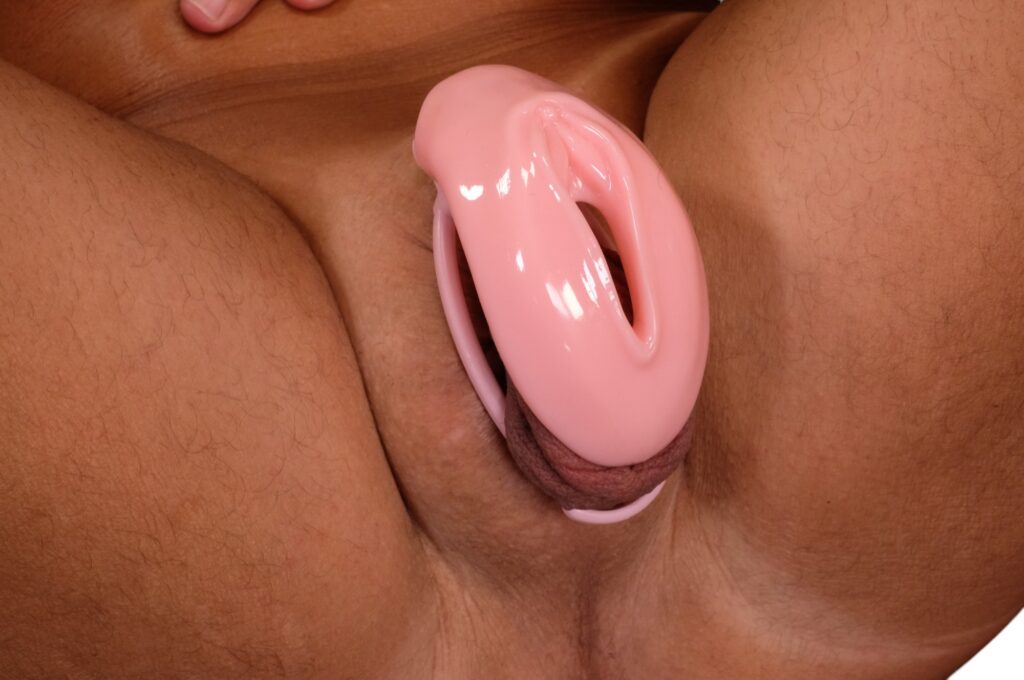
Male Chastity Cages and Trans Women: Why Pre-Op and No-Op Women Choose Them
Male chastity cages are usually marketed as sexual or relationship devices for men, but that description does not capture all the ways people use them. Some pre-op and no-op trans women, transfeminine people, and other feminine-presenting people use chastity devices for a very different purpose: controlling or minimizing the appearance of the penis and creating a flatter, smaller, or less traditionally masculine profile.
For these wearers, a chastity cage can sometimes function almost like another piece of gender-affirming clothing. Instead of emphasizing the genitals, the objective may be to contain them, minimize their prominence, or make them less noticeable beneath clothing or swimwear.
This has also encouraged the development of increasingly compact cages. Traditional cages project forward and leave a recognizable male outline. Micro, flat-profile, and inverted designs take almost the opposite approach.
Why Would a Trans Woman Wear a Chastity Cage?
There isn’t one answer. Trans women have different relationships with their bodies, and plenty have no interest in chastity devices at all.
For those who do, one motivation can be presentation.
A conventional male underwear or swimsuit pouch is normally engineered to accommodate and sometimes emphasize the penis. Someone trying to achieve a feminine silhouette may want precisely the opposite.
A compact chastity design can keep everything contained within a relatively predictable space. Depending on anatomy, clothing, and the device, that can reduce projection and make the genital area less visually prominent.
Another reason can be body comfort or gender affirmation. Some pre-op and no-op trans women dislike having their penis visually emphasized even if they have no intention of pursuing genital surgery. Seeing a smaller profile in a mirror or beneath clothing can simply feel more consistent with how they want to present themselves.
This is an important distinction. Being transgender does not automatically mean wanting genital surgery. A no-op trans woman may be perfectly comfortable retaining her existing anatomy while still preferring a feminine external appearance.
Chastity as a Feminization Tool
Historically, chastity cages were usually designed around restriction. Contemporary specialty designs have expanded well beyond that original concept.
For transfeminine wearers, the interesting characteristic is often containment rather than chastity itself.
A cage can restrict how far the penis projects from the body. As the device becomes shorter, the visible profile generally becomes more compact.
That has resulted in several broad categories:
- conventional cages
- short cages
- micro cages
- flat or low-profile cages
- inverted cages
They can produce dramatically different silhouettes.
Conventional Chastity Cages
A traditional cage extends outward from the body and encloses the shaft.
These designs may be useful for someone interested primarily in chastity, but they aren’t necessarily ideal for someone whose main objective is feminization. Even a small conventional cage can still produce an obviously projecting shape underneath tight clothing.
For some trans women, therefore, conventional cages are merely the starting point.
Short and Micro Chastity Cages
Micro cages dramatically reduce the length of the enclosure.
Instead of providing enough room for the penis to extend naturally, they are designed around a much shorter resting profile.
Visually, this can make a significant difference beneath clothing.
A standard cage might create a noticeable forward projection. A properly fitted micro cage can create a much smaller silhouette and may work better underneath panties, leggings, tight shorts, or some swimsuit styles.
This is one reason micro chastity has developed an audience beyond conventional chastity users.
For a transfeminine wearer, the objective might simply be:
less projection, less visible anatomy, and a more feminine silhouette.
The Inverted Chastity Cage
The inverted cage takes the concept substantially further.
Instead of placing the penis inside a tube extending outward from the body, an inverted design is intended to minimize outward projection by accommodating the anatomy closer to the body.
From the outside, there may consequently be very little conventional cage shape visible.
This makes inverted designs particularly interesting to people whose priority is minimizing the appearance of male genital anatomy.
Depending upon the particular device and the wearer’s anatomy, an inverted cage may produce a very compact front profile.
It doesn’t literally change someone’s anatomy or create female genitalia. What it can change is the external silhouette.
That distinction is important when comparing chastity with other feminization techniques.
Inverted Cages Versus Tucking
Tucking remains one of the most familiar techniques for creating a flatter front.
The two approaches work differently.
Tucking involves repositioning the external genitals and securing or supporting them in a flatter configuration. Specialized gaffs, panties, swimwear, and other garments can help maintain that presentation.
An inverted chastity device relies instead on a rigid or semi-rigid structure to control projection.
Neither method is universally better. Anatomy, comfort, activity level, clothing, duration of wear, and personal preference all matter.
Some people may prefer tucking for swimwear and an extremely smooth appearance. Others may appreciate the predictable containment of a compact cage. Still others use specially constructed MTF garments without either approach.
Micro Cages and the “Almost Nothing There” Look
The progression from standard cage to short cage to micro cage to inverted cage illustrates an interesting reversal in conventional men’s underwear design.
Traditional men’s clothing generally makes room for the penis.
Feminization-oriented designs often attempt to make that space disappear visually.
Consequently, some of the smallest cages are designed around an extremely reduced profile. Beneath appropriate clothing, the front may appear much flatter than it would naturally.
For a trans woman who experiences discomfort from seeing a pronounced bulge, that visual difference can be meaningful.
The objective doesn’t necessarily have anything to do with pretending the anatomy isn’t there. It can simply be about deciding how prominently that anatomy is presented to the world.
No-Op Trans Women and Chastity
No-op deserves special attention because genital surgery is sometimes incorrectly treated as an inevitable destination for every transgender woman.
It isn’t.
Some trans women want vaginoplasty. Some aren’t sure. Some cannot pursue surgery for medical, financial, or personal reasons. Others simply don’t want it.
A no-op woman can therefore look for non-surgical methods of controlling her silhouette.
These can include:
tucking garments, gaffs, compression panties, MTF underwear, specially constructed swimwear, flat-front garments, compact chastity devices, and inverted cages.
The advantage of clothing and removable devices is reversibility. A person can experiment with different presentations without making a permanent anatomical change.
Pre-Op Trans Women
Pre-op women can have somewhat different motivations.
Someone planning eventual gender-affirming surgery may still spend years living with her existing anatomy. Clothing and accessories can help her achieve the presentation she wants during that period.
A compact chastity cage is one possible option, especially when conventional men’s underwear produces a silhouette she dislikes.
It should not, however, be regarded as a substitute for medical transition or gender-affirming surgery. It is simply a presentation tool.
Chastity Cages and MTF Swimwear
Swimwear creates a particular challenge because thin, stretchy fabrics reveal contours much more readily than ordinary clothing.
A conventional men’s swimsuit typically incorporates a pouch. That pouch deliberately creates space for male anatomy.
MTF swimwear approaches the problem differently.
Some designs use compression. Others use tucking. Some use strategically positioned seams and panels. Others are designed to work with separate feminizing accessories.
A compact or inverted chastity cage can potentially be worn beneath suitable swimwear when the combination is specifically comfortable and compatible.
The objective is often to avoid the traditional forward-projecting pouch.
Instead, the wearer may prefer a smooth bikini front that visually reads more like women’s swimwear.
Chastity Isn’t the Same as Transition
It is important to separate several concepts that frequently overlap in advertising.
A chastity cage doesn’t make someone transgender.
Wearing one doesn’t medically transition someone.
Likewise, a transgender woman doesn’t need a chastity cage, tucking, surgery, hormones, or any particular swimsuit to establish her gender.
These are simply options.
For someone who actively wants genital minimization, however, the enormous variety of modern devices provides choices that didn’t exist when nearly every cage was essentially a long tube projecting from the body.
Choosing the Right Size
Smaller isn’t automatically better.
This is especially important with micro and inverted cages.
The objective should be a device that achieves the desired profile without excessive pressure, pinching, numbness, discoloration, broken skin, or impaired circulation. A device should never be forced onto anatomy simply to obtain a smaller appearance.
Sizing systems also vary considerably between manufacturers, so labels such as “micro” or “inverted” don’t guarantee a particular fit.
Anyone experiencing persistent pain, numbness, significant swelling, unusual color changes, skin injury, difficulty urinating, or other concerning symptoms should remove the device when safely possible and seek appropriate medical care if symptoms persist or are severe.
Long-term or overnight wear deserves particular caution because swelling and skin problems may develop gradually.
The Evolution From Chastity to Gender Presentation
One of the more interesting developments in this category is that a product originally associated almost exclusively with sexual chastity can also be viewed as a specialized piece of body-shaping equipment.
For some transfeminine people, the progression looks something like this:
standard cage → short cage → micro cage → low-profile cage → inverted cage
As the design becomes progressively less projecting, its purpose can shift from enclosing the penis to visually minimizing it.
That creates overlap with gaffs, tucking panties, MTF swimwear, compression garments, and other non-surgical feminization products.
Another Option in a Much Larger Toolbox
Pre-op and no-op trans women have more options for controlling their genital silhouette than ever before.
Some tuck.
Some use a gaff.
Some wear specially designed MTF panties or swimwear.
Some use compression.
Some prefer feminizing accessories.
And some choose micro or inverted chastity cages because they like the compact profile those devices can provide.
For these wearers, the cage isn’t necessarily about hiding who they are. It can be about gaining more control over how their body is presented.
That may be the most useful way to understand the relationship between male chastity cages and trans women.
The traditional cage was designed to surround and control the penis. The newest micro and inverted concepts can go a step further by minimizing how prominently it appears. For a pre-op or no-op trans woman seeking a smoother, less masculine silhouette without permanently changing her anatomy, that makes the modern chastity cage one of several increasingly specialized tools available for gender presentation.